Introduction
3D printing design education is becoming a practical bridge between creativity and real-world problem solving. It teaches learners how to turn ideas into digital models, then into physical objects. That process builds technical confidence, design thinking, and a stronger understanding of modern manufacturing.
As more schools, colleges, and training centres adopt digital fabrication, 3D printing design education is no longer a niche topic. It is now a valuable part of STEM learning, creative production, and vocational training. Students do not only learn software. They also learn how to plan, test, improve, and finish a design for a real outcome.
This matters because 3D printing rewards careful thinking. A model that looks good on screen may fail in print. A small wall thickness issue can ruin a project. A poor support choice can waste time and material. With the right 3D printing design education, learners understand these challenges before they become costly mistakes.
Why 3D Printing Design Education Matters
3D printing design education helps learners move beyond theory. It turns abstract ideas into tangible results. This makes learning more engaging, especially for visual and hands-on students. It also supports problem solving, since learners must think through form, scale, strength, and function.
In classrooms, this approach encourages experimentation. A student can design a prototype, print it, test it, and refine it. That cycle mirrors professional product development. It also builds patience and resilience. When a print fails, the lesson is not lost. It becomes part of the process.
There is also a strong career connection. Many industries now use additive manufacturing in product development, healthcare, architecture, engineering, and packaging. For that reason, 3D printing design education gives students a useful foundation for future study and work.
The best programmes also connect design with real business needs. For example, packaging, branding, and product presentation all rely on precision and creativity. A useful resource for practical brand presentation is Custom Packaging, which shows how thoughtful design choices can support professional results. For wider industry context, print & finishing insights can help learners understand how design, production, and presentation work together. For those wanting a physical reference point, the Buddy Packaging Location can be useful when exploring a local production environment.
Core Skills Taught in 3D Printing Design Education
A strong 3D printing design education programme usually begins with digital modelling. Learners first need to understand geometry, scale, and proportion. They must know how to create a shape that is both attractive and printable.
Another key skill is thinking about material behaviour. Different filaments and resins behave differently under heat, pressure, and load. A design that suits one material may fail in another. This is why 3D printing design education should always include material awareness.
Learners also need to understand print orientation. The same design can print very differently depending on how it is placed on the build plate. Good orientation can improve strength, reduce support material, and improve surface quality. That is an essential part of 3D printing design education.
Support structures, infill, wall thickness, and tolerances also matter. These are not advanced details reserved for engineers. They are basic parts of effective 3D printing design education. When learners understand them early, they produce better prints and fewer failures.
Software and Tools Used in Learning
Most 3D printing design education programmes introduce beginner-friendly design software first. These tools help learners understand forms without overwhelming them. Later, students may move into more advanced CAD platforms. The goal is steady progress, not rushed complexity.
Students also learn slicing software. This step is vital because a model must be translated into printer instructions. Slicing teaches layer height, support placement, speed, and temperature settings. Without this stage, even a good model may not print well.
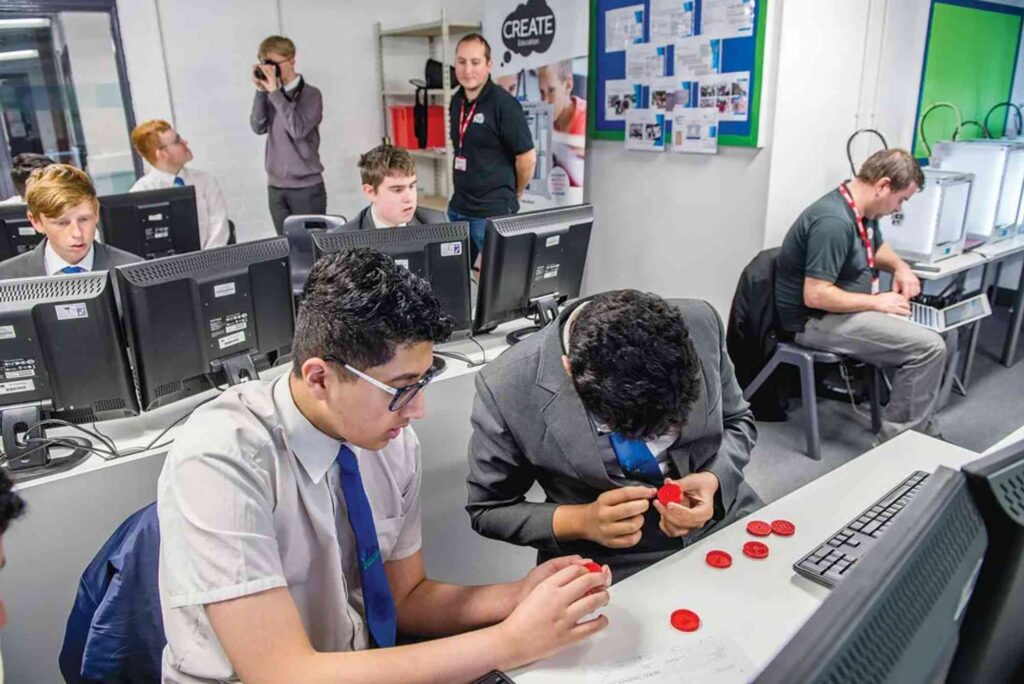
In many classrooms, design education also includes simple measurement tools and basic printers. These allow learners to test small objects quickly. That hands-on feedback is one of the biggest strengths of 3D printing design education. It turns software learning into real-world iteration. Schools that combine design, prototyping, and finishing often deliver the best results. Learners see how a digital file becomes a polished object. That experience improves both understanding and motivation.
How 3D Printing Design Education Builds Better Thinking
One of the strongest benefits of 3D printing design education is the development of design thinking. Students learn to identify problems, create solutions, test ideas, and improve outcomes. This is useful in far more than one subject.
A learner designing a simple part must consider strength, appearance, function, and time. That process encourages careful decision-making. It also teaches that every choice has a trade-off. A thicker wall may add strength, but it may also use more material. A detailed surface may look better, but it may be harder to print.
This kind of thinking is valuable in business too. Product design, retail packaging, and branded merchandise all depend on clear planning. A well-designed item must look professional and work reliably. That is why 3D printing design education supports both creativity and commercial awareness. It also improves confidence. Students often begin with simple objects. Then they progress to more complex models. Each success reinforces the idea that technical skills can be learned. That sense of progress keeps learners engaged.
Classroom Applications and Real-World Value
3D printing design education can be applied across many subjects. In science, students can build models of cells, molecules, or ecosystems. In mathematics, they can explore measurement, symmetry, and geometry. In art and design, they can create sculptures, jewellery, or prototypes. It also works well in engineering and technology courses. Learners can design gears, brackets, or housings. They can test fit and function. That makes learning more practical and memorable. It also gives teachers a clear way to connect theory with action.
Outside the classroom, 3D printing design education has strong real-world value. Small businesses use it for prototypes, product samples, and custom items. Designers use it to test ideas before mass production. Makers use it to create personalised objects quickly and affordably.
This is where good design discipline becomes important. A printed object must not only look attractive. It must also be structurally sound and suitable for its purpose. Learners who understand this are better prepared for both employment and entrepreneurship.
Common Challenges in Learning 3D Printing Design
Many learners face similar problems at first. One common issue is overcomplicated designs. Beginners often add too much detail too soon. That can cause print failures and frustration. Good 3D printing design education teaches simplicity first, then complexity later.
Another challenge is ignoring printer limits. A model may look impressive, but still be unsuitable for the machine. Overhangs, thin sections, and unsupported bridges can lead to poor results. Students need to learn that design and machine capability must work together. File preparation is another area where mistakes happen. Incorrect dimensions or poor mesh quality can affect the final print. This is why 3D printing design education should include quality checks before printing begins.
Time management can also be difficult. Some learners underestimate how long testing takes. Yet testing is not wasted time. It is where real learning happens. The best training builds this habit early, so students accept iteration as part of good design.
How Educators Can Improve Learning Outcomes
Teachers and trainers play a major role in 3D printing design education. Clear demonstrations help learners understand the workflow. Step-by-step examples are often more effective than long explanations. Students should see how a digital model becomes a finished object.
Feedback is also crucial. Learners benefit from specific comments on wall thickness, orientation, scale, and shape. Vague praise is less useful than practical guidance. Strong 3D printing design education focuses on improvement, not just completion.
It also helps to use real project briefs. A mock product, an educational aid, or a branded object gives students a real purpose. That increases engagement. It also shows how design works in a professional setting.
Finally, educators should encourage reflection. After each print, students can review what worked and what failed. That habit builds deeper understanding. Over time, it improves both technical skill and creative confidence.
The Link Between 3D Printing and Presentation
Design does not stop when the print is finished. Presentation matters too. A clean surface, clear colour choice, and thoughtful finishing can make a model feel professional. This is especially important in branding and packaging.
That is why 3D printing design education should not ignore finishing techniques. Sanding, priming, assembly, and visual presentation all affect the final result. A well-finished object communicates care and quality. It also helps students understand how design is experienced in the real world. This point is especially relevant for businesses. When products are shown to clients or customers, first impressions matter. A polished prototype can support sales, testing, and approval. In that sense, 3D printing design education connects directly with communication and market readiness.
3D printing design education is more than learning software. It is a complete process that builds creativity, technical skill, and practical thinking. It helps students understand how ideas become objects, and how design choices affect real outcomes.
In education, it strengthens STEM learning and encourages experimentation. In business, it supports prototyping, branding, and product development. In both cases, the value is clear. Learners gain skills that are useful, adaptable, and future-focused. If you are building content, a course, or a classroom programme around 3D printing design education, focus on clarity, practice, and real-world application. That combination creates better results and deeper understanding.
Explore creative ways to enhance your fashion line with custom dress printing. Our guide on dress printing designs helps brands bring unique patterns to life, ensuring standout pieces for any collection. Learn more about innovative techniques and ideas by visiting our dress printing designs page for inspiration.
FAQs
What is 3D printing design education?
It is the process of teaching people how to create digital models for 3D printing. It covers design software, print preparation, materials, and testing.
Why is 3D printing design important in schools?
It helps students learn problem solving, spatial thinking, and digital making. It also connects classroom learning with practical applications.
What skills do you need for 3D printing design education?
Learners need basic digital design skills, measurement awareness, and an understanding of printer settings. Patience and testing are also important.
How do I start learning 3D printing design?
Begin with simple modelling software and small projects. Focus on basic shapes, scale, and printability before moving into advanced designs.
What are the benefits of 3D printing in education?
It improves engagement, supports hands-on learning, and helps students see ideas become real objects. It also encourages creativity and iteration.