Introduction
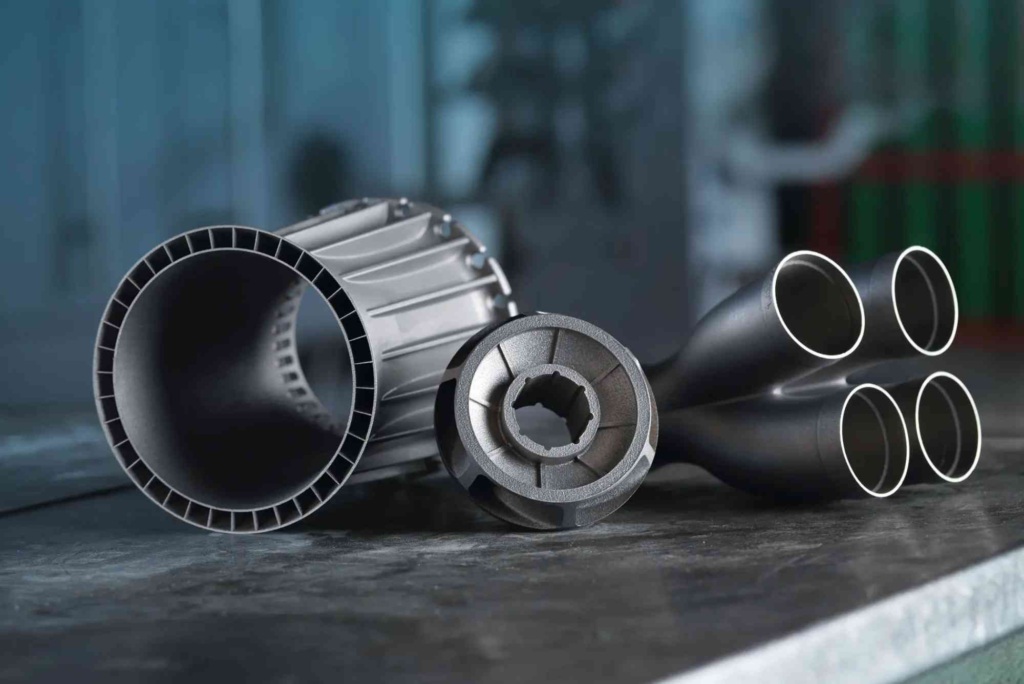
Metal additive manufacturing has moved from prototyping to full-scale production across aerospace, automotive, medical, and industrial sectors. If you’re serious about designing parts for performance, weight reduction, and manufacturing efficiency, this metal 3d printing design guide will walk you through everything you need to know.
Unlike traditional machining or casting, metal 3D printing allows you to rethink geometry, reduce assemblies, and optimize internal structures. However, designing for metal additive manufacturing (DfAM) requires a completely different mindset. This guide explains the principles, constraints, and expert strategies that lead to successful prints.
Introduction to Metal 3D Printing
Metal 3D printing—also known as metal additive manufacturing (AM)—builds components layer by layer using metal powder or wire feedstock. The most widely used industrial processes include:
- Powder Bed Fusion (PBF)
- Direct Energy Deposition (DED)
- Binder Jetting
Industries such as aerospace, medical implants, and automotive engineering rely on these technologies for high-performance parts.
Designing without understanding process physics often results in distortion, cracking, or failed builds. That’s why following a structured metal 3d printing design guide is essential for predictable results.
Understanding Design for Additive Manufacturing (DfAM)
Rethinking Traditional Design Rules
Traditional manufacturing restricts geometry due to tooling, molds, or cutting tool access. Metal 3D printing removes many of those constraints but introduces new ones, such as thermal stress and support requirements.
Instead of asking:
“Can this be machined?”
You now ask:
“Can this be printed without distortion or excessive supports?”
Design Freedom vs. Process Constraints
Metal AM offers:
- Complex internal channels
- Topology-optimized structures
- Lattice infills
- Part consolidation
But it also requires:
- Proper support planning
- Thermal stress management
- Orientation optimization
This balance is at the core of any effective metal 3d printing design guide.
Material Selection for Metal 3D Printing
Material choice impacts mechanical properties, printability, cost, and finishing requirements.
Common Metal AM Materials
- Stainless Steel (316L)
- Aluminum Alloys (AlSi10Mg)
- Titanium (Ti6Al4V)
- Inconel 718
- Tool Steels
Each material behaves differently under thermal cycling. Titanium, for example, is lightweight and strong but sensitive to thermal stress. Inconel handles high temperatures but may require post-processing heat treatment.
Matching Material to Application
Aerospace engineers often choose titanium for weight reduction. Medical device designers favor biocompatible alloys. Automotive manufacturers may opt for aluminum to improve efficiency.
Material selection should align with:
- Load requirements
- Environmental exposure
- Certification standards
- Post-processing capabilities
Designing for Supports and Overhangs
Support structures are necessary in most powder bed fusion systems.
Overhang Angles
Most metal AM systems require supports for overhangs below 35–45 degrees (depending on material and machine).
Design tip:
- Avoid flat downward-facing surfaces.
- Use self-supporting angles when possible.
Minimizing Supports
Reducing supports lowers:
- Post-processing time
- Surface damage risk
- Material waste
- Production cost
Strategies include:
- Adding chamfers instead of sharp overhangs
- Redesigning features to eliminate downward faces
- Reorienting the part
This optimization process is fundamental in a professional metal 3d printing design guide.
Part Orientation Strategy
Part orientation dramatically affects:
- Surface finish
- Build time
- Support quantity
- Mechanical strength
- Thermal stress distribution
Key Orientation Principles
- Minimize large cross-sectional areas per layer
- Align critical surfaces vertically for better finish
- Reduce tall, thin structures
- Position high-precision areas away from heavy supports
In real-world production, I’ve seen orientation changes reduce support material by 30–40% and cut post-processing time in half.
Managing Thermal Stress and Distortion
Metal 3D printing involves rapid heating and cooling. This creates residual stresses that can warp parts or cause cracking.
Strategies to Reduce Distortion
- Uniform wall thickness
- Avoid sharp internal corners
- Add fillets and radii
- Include stress-relief features
- Use simulation software
Thermal simulation tools predict distortion before printing, saving both material and machine time.
Designing Internal Channels and Lattices
One of the biggest advantages of metal AM is internal complexity.
Conformal Cooling Channels
Used in molds and tooling, conformal channels improve heat dissipation and cycle time.
Design considerations:
- Maintain minimum diameter (usually 1–2 mm depending on system)
- Avoid unsupported horizontal tunnels
- Ensure powder removal paths
Lattice Structures
Lattices reduce weight while maintaining structural strength. They are commonly used in:
- Aerospace brackets
- Medical implants
- Performance automotive components
This capability defines modern innovation in any advanced metal 3d printing design guide.
Tolerances and Surface Finish
Metal AM does not automatically deliver CNC-level tolerances.
Typical As-Printed Tolerances
- ±0.1 mm to ±0.3 mm (depending on geometry and machine)
Critical interfaces often require:
- Machining
- Grinding
- Polishing
Surface Roughness
Powder bed fusion typically results in rough surfaces (Ra 6–15 µm). If your design requires smooth surfaces, plan secondary finishing operations.
Design for Post-Processing
Post-processing is not optional—it’s part of the workflow.
Common steps include:
- Support removal
- Heat treatment
- Hot Isostatic Pressing (HIP)
- CNC machining
- Surface finishing
Design with tool access in mind. If machining is required, add stock allowance to those surfaces.
Lightweighting and Topology Optimization
Topology optimization software removes unnecessary material while maintaining load paths.
Benefits:
- 30–60% weight reduction
- Improved strength-to-weight ratio
- Material cost savings
However, optimized shapes must still follow the rules of a structured metal 3d printing design guide—including support strategy and thermal management.
Design Validation and Testing
Before full production:
- Print small validation samples
- Test mechanical performance
- Inspect internal geometry via CT scanning
- Confirm dimensional accuracy
Certifications in aerospace and medical industries demand repeatability and documentation.
Metal 3D Printing and Packaging Innovation
Metal AM isn’t limited to mechanical components. It’s increasingly used in tooling for packaging molds and precision dies.
If you’re in manufacturing or product presentation, integrating advanced tooling with Custom Packaging solutions can elevate brand performance. For businesses seeking labeling and finishing solutions, check out Custom Packaging.
For creative inspiration and broader packaging design tips, explore expert insights at packaging design tips.
You can also visit the physical presence of the supplier here: Buddy Packaging Location.
Cost Optimization in Metal 3D Printing
Metal AM can be expensive if poorly designed.
Cost Drivers
- Build time
- Material consumption
- Support volume
- Post-processing effort
- Machine utilization
How to Reduce Costs
- Consolidate multiple parts into one
- Minimize supports
- Optimize orientation
- Use lattice structures
- Batch production builds
Cost awareness is a vital section in any complete metal 3d printing design guide.
Common Mistakes to Avoid
- Designing like it’s CNC machining
- Ignoring support removal accessibility
- Using inconsistent wall thickness
- Overlooking powder removal paths
- Skipping stress analysis
Avoiding these mistakes dramatically increases success rates and reduces scrap.
Future Trends in Metal 3D Printing
- Multi-material printing
- Faster laser systems
- AI-driven build optimization
- Sustainable metal powders
- Automated post-processing
As machines improve, design strategies must evolve. A living metal 3d printing design guide adapts with technology advancements.
FAQs
What are the design rules for metal 3D printing?
Design rules include maintaining proper wall thickness, minimizing unsupported overhangs, managing thermal stress, optimizing orientation, and designing for post-processing. Following a structured metal 3d printing design guide ensures reliable results.
What is the minimum wall thickness for metal 3D printing?
Typically 0.5 mm to 1 mm, depending on material and machine. However, functional parts often require thicker walls for strength and durability.
Does metal 3D printing require support structures?
Yes, especially in powder bed fusion systems. Supports prevent distortion and anchor overhangs during the build process.
How accurate is metal 3D printing?
Most industrial systems achieve ±0.1–0.3 mm accuracy. Critical features usually require secondary machining.
Is metal 3D printing stronger than traditional manufacturing?
It depends on material and post-processing. With proper heat treatment and HIP, metal AM parts can match or exceed traditionally manufactured components.
Metal additive manufacturing offers unmatched design freedom—but only if approached correctly. Understanding supports, orientation, material behavior, thermal stress, and post-processing is critical for success.