For decades, the educational technology industry operated on a simple, albeit flawed, premise: more features equal better learning. Software companies raced to build monolithic platforms—massive suites and sprawling Learning Management Systems (LMS) packed with every conceivable bell and whistle. The goal was to create a single, unified digital campus where a student could write an essay, take a quiz, chat with peers, and build a 3D model, all in one place.
But a quiet revolution is happening in how we study, upskill, and process information. The era of bloated, “jack-of-all-trades” software is ending. In its place, a new paradigm is taking over: the rise of the micro-learning tool.
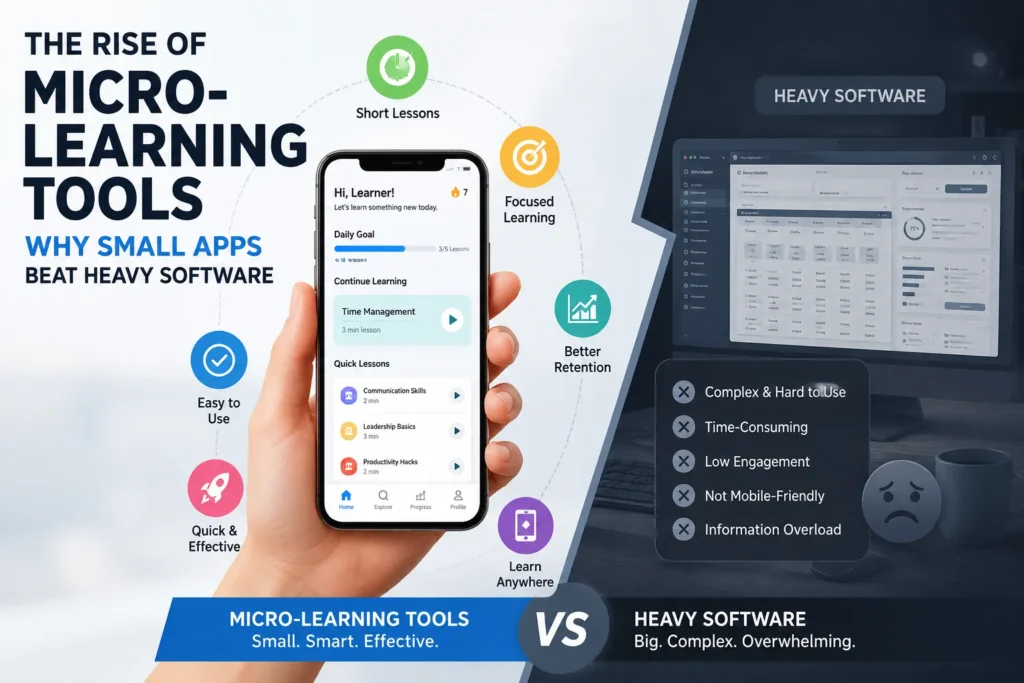
Today’s most effective learners are abandoning heavy software in favor of agile, single-purpose web apps. They are trading steep learning curves for instant utility. To understand why small apps are consistently beating out their heavyweight competitors, we have to look at the psychology of learning, the economics of attention, and the fundamental shift toward what we call Smart Micro-Tools.
The Heavy Software Problem: Friction and Cognitive Overload
To understand the appeal of micro-tools, we first need to acknowledge the problem with heavy software.
Think about the last time you opened a complex, professional-grade software suite to complete a simple homework task. Before you could even begin thinking about the subject matter, you had to navigate splash screens, bypass mandatory updates, sift through a maze of drop-down menus, and configure your workspace.
In educational psychology, there is a concept known as Cognitive Load Theory. It suggests that our working memory has a limited capacity. When you sit down to learn, your brain has to allocate energy to processing the actual information (intrinsic load). However, if the software you are using is overly complex, confusing, or cluttered, it creates an unnecessary mental burden (extraneous load).
Heavy software maximizes extraneous cognitive load. Friction is the absolute enemy of the flow state. When a tool tries to do everything, it often ends up doing nothing particularly well, leaving the user overwhelmed and exhausted before the actual learning has even begun.
The Anatomy of a Micro-Learning Tool
A micro-learning tool is the exact opposite of a bloated software suite. It is built on a philosophy of aggressive minimalism. A true micro-tool does one thing, and it does it perfectly.
- The Single-Purpose Thesis: Instead of a word processor with 500 formatting options, a micro-tool is a blank browser tab that only highlights passive voice.
- Zero Onboarding: You don’t need a tutorial to use a micro-tool. The user interface is so intuitive that the learning curve is practically non-existent.
- Browser-Native: There is nothing to download, no heavy installation files, and no local storage requirements. It lives in a browser tab and loads in milliseconds.
- Frictionless Entry: You can usually start using it without even creating an account or logging in.
Why Small Apps Win the Learning War?
The shift toward micro-tools isn’t just a technological trend; it is a psychological one. Small apps align far better with how the modern human brain operates.
1. They Capitalize on Shrinking Attention Spans
We live in an attention economy where focus is highly fragmented. Forcing a student to sit down for a two-hour session inside a clunky LMS is an uphill battle. Micro-tools, on the other hand, are designed for micro-sessions.
Whether it is flipping through a digital flashcard deck for five minutes while waiting for the bus, or using a browser-based Pomodoro timer to power through a 25-minute reading sprint, small apps allow learners to steal back pockets of time. They facilitate “spaced repetition”—a scientifically proven method of learning where information is reviewed in short, spaced-out intervals rather than crammed all at once.
2. They Provide Immediate Dopamine Hits
Heavy software delays gratification. You might spend hours setting up a project before you see a tangible result. Micro-tools engineer quick wins.
When you type a complex equation into a browser-based graphing calculator and it instantly renders a beautiful, interactive parabola, your brain receives a micro-dose of dopamine. When a citation generator instantly formats a perfect MLA bibliography entry from a pasted URL, you feel a sense of immediate relief and accomplishment. This rapid feedback loop keeps learners motivated, engaged, and moving forward.
3. They Allow for a Custom “Tech Stack”
In the corporate world, professionals no longer buy one software suite to run their entire business. They build a “tech stack”—a curated collection of specialized apps (Slack for chat, Notion for wikis, Figma for design) that integrate together.
Students and self-guided learners are adopting this exact same strategy. Instead of relying on whatever bulky software their school provides, they are curating their own highly personalized digital toolbelts. They bookmark one specific web app for summarizing articles, another for organizing their schedule, and a third for editing their grammar. This modular approach means that if a better flashcard app hits the market tomorrow, the learner can simply swap it out without disrupting their entire workflow.
Edufigure and the “Smart Micro-Tools” Philosophy
This modular, frictionless approach to education requires a new kind of navigation. If the future of learning is a decentralized web of brilliant, single-purpose apps, learners need a compass to help them find the right tool for the right moment.
This is the driving philosophy behind https://edufigure.com/.
Aligned perfectly with the tagline “Smart Micro-Tools,” Edufigure recognizes that the modern learner doesn’t want to be weighed down by digital baggage. Educational hubs built on this principle act as curators, cutting through the noise of the internet to connect students with the exact, lightweight tools they need to overcome specific academic hurdles.
Platforms championing the micro-tool revolution understand that intelligence isn’t about how complex your software is; it’s about how efficiently you can achieve the desired outcome. By highlighting focused, browser-based applications, Edufigure empowers students to build a bespoke educational ecosystem that actually works for them, rather than forcing them to adapt to the constraints of legacy software.
The Future is Lightweight
The transition from heavy educational software to micro-learning tools mirrors the broader evolution of technology: from the mainframe, to the desktop, to the cloud, to the hyper-focused web app.
As we look toward the future of education, the winners will not be the developers who build the biggest platforms with the most features. The winners will be those who figure out how to remove the most friction.
For students, educators, and lifelong learners, the message is clear: stop trying to force bulky, complex software into your workflow. Embrace the modularity of the modern web. Curate your bookmarks, seek out single-purpose applications, and build a digital toolkit that is as agile, dynamic, and focused as your own mind. The tools you need to succeed are already out there—and they are lighter, faster, and smarter than ever before.